How to Select the Best NIFT Campus in India for Fashion Design Aspirants
Understand What NIFT Actually Offers Across Its Campuses
The Top NIFT Campuses and Their Unique Strengths
Choosing the right campus after you clear the entrance exam is one of the most important decisions for anyone looking for a career in fashion design. All campuses may give you the same degree, but the learning environment, industry exposure and peer group may differ widely. Knowing these differences can help you make a choice that is in line with your long-term career goals. The points below explain each major campus and its unique strengths.
- NIFT Delhi: Established in 1986, NIFT Delhi is the first NIFT institution and carries the deepest alumni network and the strongest placement record in the system. The campus has the highest seat intake among all NIFT locations and consistently attracts top recruiters from luxury retail, fast fashion, and export houses. If your ambition is to enter premium segment fashion brands or pursue post-graduation abroad, the Delhi campus carries the most weight on a resume.
- NIFT Mumbai: This campus is the natural choice for students whose career interests lie in the commercial fashion industry, that include export, retail buying, fashion communication, and fashion business. Mumbai's proximity to the country's largest garment export clusters and fashion media houses gives students practical exposure that no classroom can replicate.
- NIFT Bangalore: This campus has grown significantly in stature over the past decade. The city's booming retail and technology ecosystem makes it particularly relevant for students interested in the intersection of fashion and digital retail, sustainable fashion, and textile innovation.
- NIFT Chennai and NIFT Kolkata: Both are great campuses with well-established placement records, particularly for students interested in textile and apparel manufacturing. Kolkata's historical ties to the handloom and jute industries give it a distinct character, while Chennai's campus benefits from its proximity to Tamil Nadu's robust textile manufacturing base.
- NIFT Gandhinagar and NIFT Hyderabad: These campuses are consistently mentioned among the better-performing mid-tier campuses. Gandhinagar draws strength from Gujarat's thriving textiles and handicraft ecosystem, which translates into meaningful industry projects and internship access. Hyderabad has built a steady reputation in design and fashion communication placements.
Campuses such as Kannur, Patna, Jodhpur, Bhopal, and Kangra tend to serve students who are closer to those regions and who seek a less competitive admission environment. They are by no means inferior in terms of the degree they award. It is the same NIFT qualification, but the placement infrastructure, visiting faculty network, and peer competition levels differ from the older, metropolitan campuses.
Factors That Should Guide Your Campus Choice
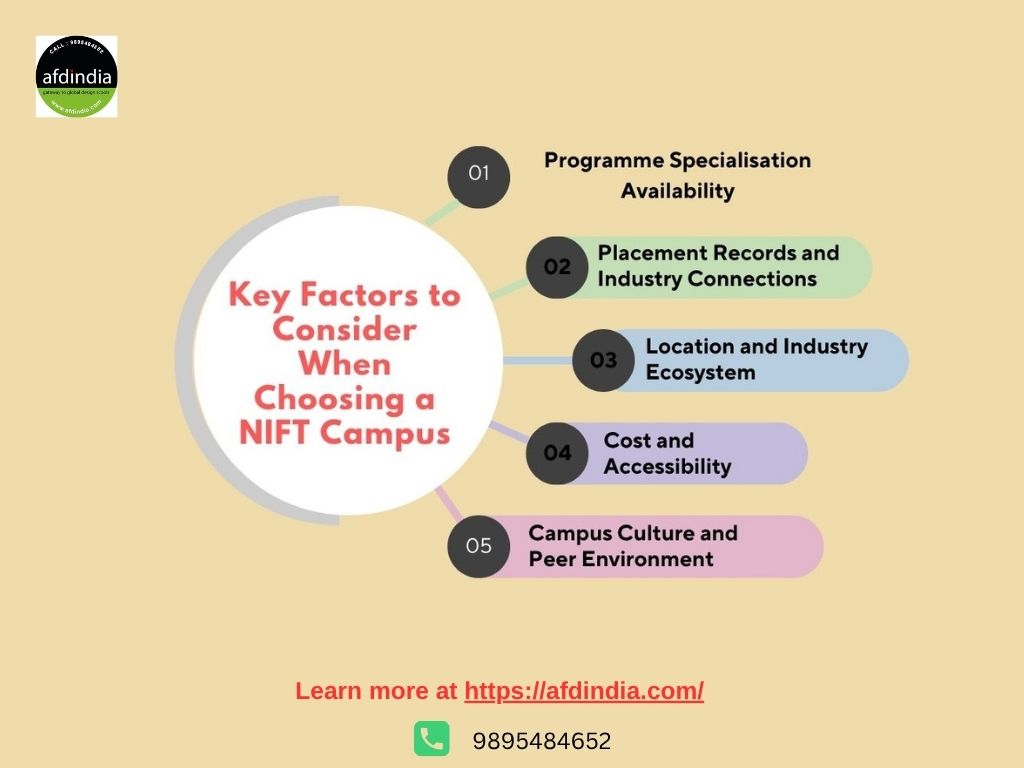
Choosing a NIFT campus is about aligning your education with your academic interests, career direction, and personal circumstances. While all campuses offer the same degree, the experience and outcomes can vary based on several important factors. Consider these factors to evaluate your options more effectively.
1. Programme Specialisation Availability
Not every NIFT campus offers every programme. Before you rank your campus preferences, verify which courses are available at each location. A student keen on Fashion Communication or Leather Design, for instance, will find that fewer campuses offer these programmes than the more popular Fashion Design or Apparel Production options. Choosing a campus without confirming your desired programme's availability is a mistake I see students make every single year.
2. Placement Records and Industry Connections
Ask specifically about placement data for your chosen programme, not the campus overall. A campus may have excellent placements for B.F.Tech, while being average for M.Des. NIFT Delhi, Mumbai, and Bangalore consistently report the strongest placement outcomes across programmes, with top recruiters including Aditya Birla Fashion & Retail, Manyavar, Arvind, and several international fashion labels. Beyond average salary figures, pay attention to the quality of companies and brands that align with where you want to work in five years.
3. Location and Industry Ecosystem
Fashion is a deeply geography-linked industry in India. If you want to work in luxury retail, Delhi is irreplaceable. If your interest is garment exports or retail buying, Mumbai makes the most sense. A student drawn to handlooms and craft-based fashion will benefit from proximity to weaving clusters, which makes campuses in Kannur, Kolkata, or Gandhinagar more relevant than Delhi might be. Think about where you want to work after graduation and work backwards from that.
4. Cost and Accessibility
NIFT fees are broadly similar across campuses, but living costs differ significantly. Delhi and Mumbai are among the most expensive cities in India, while campuses in Patna, Shillong, or Raebareli offer a considerably lower cost of living. For students from middle-income families, this is a real and legitimate consideration. A four-year programme difference in living expenses can amount to several lakhs, which matters when you are starting your career.
5. Campus Culture and Peer Environment
This is the factor students overlook most, yet it shapes their four years profoundly. The older campuses attract a more competitive and diverse peer group that brings students from across the country who scored highly in the NIFT entrance exam. This competitive environment pushes creative standards higher and leads to stronger collaborative work. Newer or smaller campuses can offer a more intimate environment, which suits some students better. Neither is objectively superior, but the question is what kind of learning environment brings out the best in you.
A Word on the NIFT Entrance Exam Score and Campus Allocation
After the NIFT entrance exam, which includes a Creative Ability Test (CAT), a General Ability Test (GAT), and a Situation Test for design programmes, students are allocated campuses based on merit rank and preference. The higher your rank, the greater your choice. NIFT Delhi typically requires the highest rank to secure a seat, followed by Mumbai and Bangalore. This is itself informative, as the cutoff ranks reflect where serious students, guided by their coaches and parents, want to study.
If your rank gives you access to a top campus for a programme that is your second preference versus a newer campus for your first-preference programme, think carefully. It is almost always better to study your chosen programme at a campus with stronger placement infrastructure than to take a prestigious campus name for a course that does not align with your career goals.
Start with the Right Foundation
Selecting the best NIFT campus is not a decision to be made on rankings alone. It requires an honest assessment of your programme preference, career goals, financial situation, and learning style. The students I have seen make the most of their NIFT education are those who went in with clarity, not just about which campus they wanted but about why they wanted it.
At afdindia, we work with NIFT aspirants from the very beginning of their preparation journey, helping them not only crack the entrance exam but also make well-informed decisions about campus selection that align with long-term career goals. Guidance at this stage is an investment in the four years ahead. If you are preparing for NIFT 2026 or 2027 and want mentorship that goes beyond exam coaching, reach out to us. The right campus, pursued with the right preparation and perspective, can be the foundation of a remarkable career in fashion.
India's No.1 Design Coach
Julie James
Helping students crack NIFT, NID, UCEED & CEED since 1999!
Ms Julie James has been mentoring students to crack design entrance exams such as NIFT, NID, UCEED, CEED & NATA since 1999. A post-grad from NIFT- New Delhi, Ms. James has 25+ years of experience in design education. She has worked in the fashion industry in various capacities after her graduation. As HOD, she has been instrumental in setting up the fashion design department at Assumption College under MG University. At afdindia, she coordinates academics and designs curricula based on the latest changes in question paper patterns. Her creative teaching methods have enabled the institute to achieve great success rate.

Hostels
Take the AFDSAT
get upto 90% scholarship







Kochi Center
3rd Floor, MI arcade, NH 47, Near Metro pillar 381, Edappally Toll, Ernakulam, Kochi, Cochin
Ph: 9895484652
Kannur Center
2nd Floor, Emarald Complex,
Kakkad Road, South Bazzar, Kannur,
Ph: 9895484651
Calicut Center
2nd Floor, City Tower,
Mavoor Road, Kozhikode
Ph: 9895484651